

Article: Cleaning vs. Conditioning a Baseball Glove: What’s the Difference?
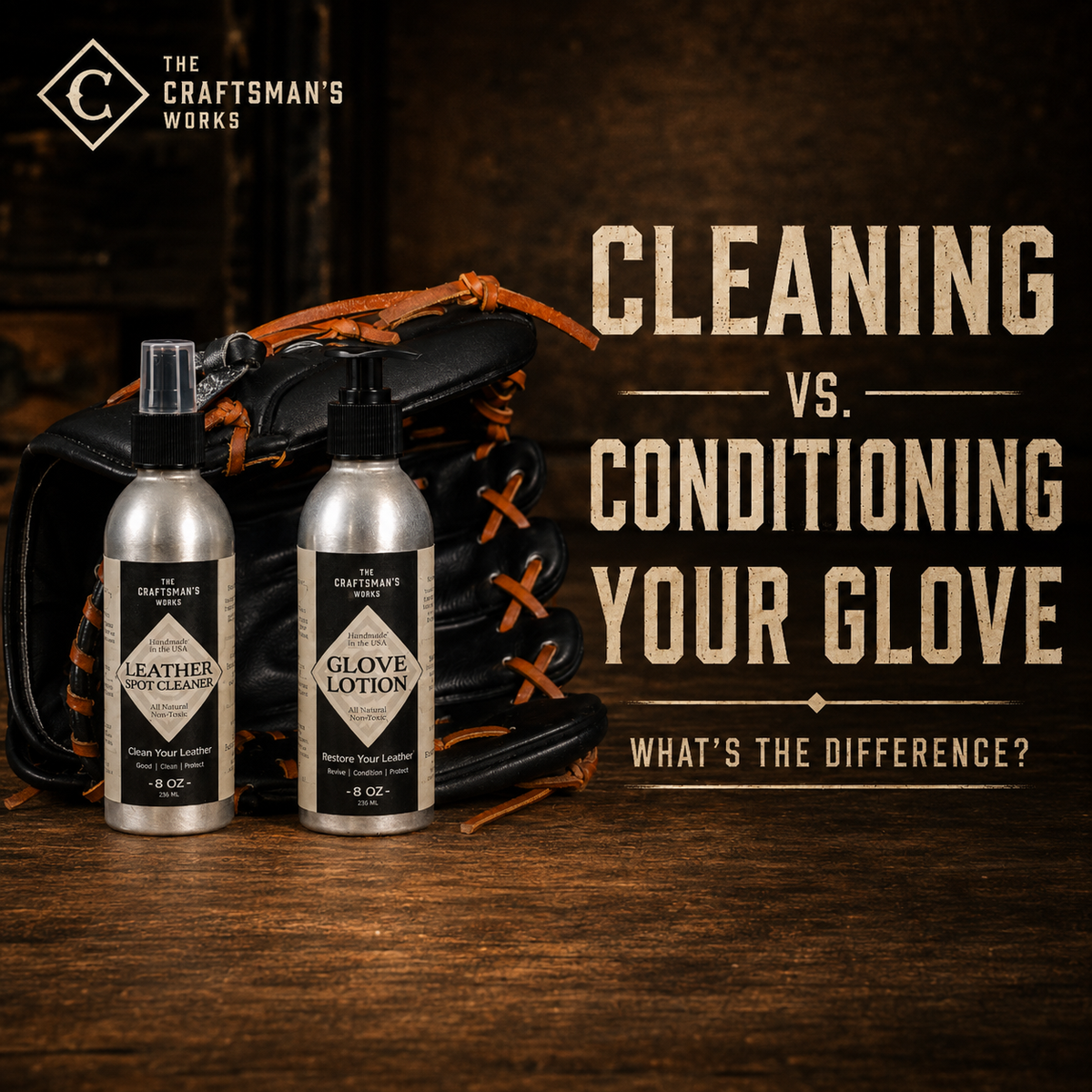
Cleaning vs. Conditioning a Baseball Glove: What’s the Difference?
Baseball gloves take a beating.
They collect dirt, dust, sweat, clay, grass stains, and grime during normal use. At the same time, the leather slowly loses the oils and moisture that help keep it flexible.
That’s why proper glove care usually involves two different jobs: cleaning and conditioning.
They are not the same thing, and using one when you really need the other can leave your glove dirty, dry, over-softened, or weighed down.
Here’s the difference.
What Does Cleaning a Baseball Glove Do?
Cleaning removes material that does not belong on the leather.
That includes things like:
- Dirt
- Dust
- Field clay
- Sweat buildup
- Mud
- Surface grime
- Some stains and discoloration
The goal of cleaning is to get the leather back to a clean surface before you do anything else to it.
For normal glove maintenance, you usually do not need to soak the glove or scrub aggressively. A gentle leather-safe cleaner and a clean rag are often enough.
At The Craftsman’s Works, we recommend Leather Spot Cleaner for this step because it is designed specifically for removing grime from baseball glove leather without requiring harsh treatment.
A good rule to remember is: If the glove is dirty, clean it.
What Does Conditioning a Baseball Glove Do?
Conditioning does something completely different.
Instead of removing dirt, conditioning helps replenish the leather.
Leather naturally dries over time. Heat, sun, sweat, water, age, and regular use can all contribute to moisture and oils being lost from the leather.
When that happens, the glove may begin to feel:
- Dry
- Stiff
- Rough
- Less flexible
- More prone to cracking
Conditioning helps restore some of what the leather has lost.
A product like Glove Lotion is designed for this purpose. It can be applied lightly to dry leather to help bring back flexibility and keep the glove from becoming brittle.
Another simple rule: If the glove is dry, condition it.
Cleaning and Conditioning Are Not Interchangeable
This is where a lot of glove owners get confused.
A conditioner does not clean dirt out of the leather.
And a cleaner does not replace the oils and moisture that dry leather needs.
If you apply conditioner to a dirty glove, you may simply be working product into dirt and grime that should have been removed first.
If you clean a glove repeatedly without conditioning it when needed, the leather may eventually become dry.
That’s why cleaning and conditioning should be thought of as separate steps.
Which Comes First?
Cleaning comes first.
If the glove needs both cleaning and conditioning, the proper order is:
- Remove loose dirt with a clean rag
- Clean the leather
- Let the glove dry completely
- Apply conditioner
- Let the conditioner absorb
- Add protection if needed
This order matters because conditioner absorbs better into clean leather.
You do not want to seal grime underneath a layer of conditioner or salve.
How Often Should You Clean Your Glove?
There is no exact schedule that works for every player.
Some gloves get dirty quickly because they are used on dusty or muddy fields. Others stay relatively clean for long stretches.
The easiest approach is to inspect the glove regularly. After every practice or game, or every Sunday evening after a tournament, is a good way to approach cleaning.
After games or practices, wipe away loose dirt with a clean rag. If grime begins to build up, use Leather Spot Cleaner as needed.
You do not have to deep-clean the entire glove every week. Routine cleaning is about preventing buildup before it becomes a bigger problem.
How Often Should You Condition Your Glove?
Conditioning should be based on the condition of the leather, not the calendar.
If the glove feels healthy, flexible, and properly broken in, it may not need conditioner at all.
If the leather begins to feel dry, a light application of Glove Lotion may be appropriate.
The key is to avoid over-conditioning.
Too much conditioner can:
- Make the glove too soft
- Add unnecessary weight
- Cause the glove to lose structure
- Change the way the pocket closes
More product is not better. The goal is to maintain healthy leather, not make the glove as soft as possible.
Where Does Glove Salve Fit In?
Glove Salve is useful as a finishing step after the glove is clean and properly conditioned.
Once Glove Lotion has absorbed, a light coat of Glove Salve can help condition and protect the surface of the leather.
Think of the routine this way:
Leather Spot Cleaner = Clean
Glove Lotion = Restore
Glove Salve = Protect
Each product has a different job.
Together, they form a complete glove-care routine.
What If My Glove Looks Dirty but Feels Soft?
Clean it.
Do not automatically condition a glove just because you are doing maintenance.
If the leather still feels healthy and flexible, it may only need cleaning.
This is one of the easiest ways to avoid over-conditioning.
What If My Glove Looks Clean but Feels Dry?
Condition it.
A glove does not have to look dirty before the leather begins to dry out.
If the surface feels stiff, rough, or noticeably less flexible than usual, a light conditioning may be all it needs.
Can You Clean and Condition a Glove on the Same Day?
Usually, yes, but do not rush the process.
After cleaning, allow the glove to dry completely in the open air before applying conditioner.
Do not put conditioner onto damp leather.
Once the glove is dry, apply a light coat of Glove Lotion and give it time to absorb.
If you are finishing with Glove Salve, allow the lotion to settle into the leather first.
The Biggest Mistake: Treating Every Glove the Same
Glove care should be based on what the leather actually needs.
A new glove, a 10-year-old gamer, and a vintage restoration may all require completely different levels of cleaning and conditioning.
Before applying anything, ask two questions:
Is the glove dirty?
If yes, clean it.
Is the leather dry?
If yes, condition it.
That simple approach prevents a lot of unnecessary damage.
A Simple Baseball Glove Care Routine
Proper baseball glove care does not have to be complicated.
Remember: Clean dirt. Condition dry leather. Protect when needed.
Use Leather Spot Cleaner to remove dirt and grime.
Use Glove Lotion to replenish leather that has become dry.
Finish with Glove Salve when you want an additional layer of conditioning and protection.
When each product is used for the job it was designed to do, your glove can maintain its feel, shape, and durability for much longer.
A good glove is built to last.
Proper care helps make sure it does.

Leave a comment
This site is protected by hCaptcha and the hCaptcha Privacy Policy and Terms of Service apply.